Constructing file formats for upload
Delimited files
To import the file format for a delimited file, create a text document with the field names listed one per line describing the structure of the file to Delphix. The screenshot below shows the contents of an example delimited file format. 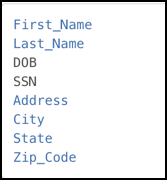
Notice there is no header and only a list of values.
Delimited file mismatch between format and data
Suppose the following delimited file format is being used, where the delimiting character on input is ,.
FieldOne
FiledTwo
FiledThree
If the input data does not match the format:
-
Input Field Count < Format Field Count
After masking, delimiters will be appended to match the total fields with file format. For example:-
Input data: Data1, Data2
-
Result after masking: Masked1, Masked2,
-
Note, one extra delimiter is added to match with the file format.
-
-
-
Data Field Count > Format Field Count
After masking, the extra fields in the delimited file will be lost. For example:-
Input data: Data1, Data2, Data3, Data4
-
Result after masking: Masked1, Masked2, Masked3
-
Fixed-width files
For fixed-width files, import a text file that describes the structure of the file to Delphix Continuous Compliance.
To input the file format for fixed-width files, create a text document with the field names and the length of each field, one combination per line. The screenshot below shows an example of content for fixed-width formats. In this format, the field name is followed by the length of the field, separated by a comma.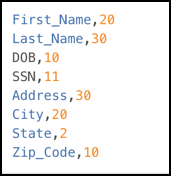
Note, there is no header – only a list of values.
XML files
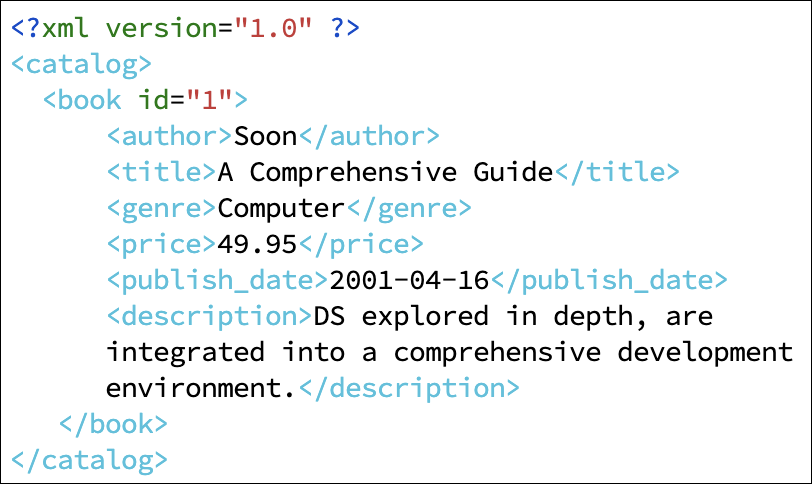
For XML file formats, you can use the data file itself or a subset of the file you want to mask as the format.
JSON files
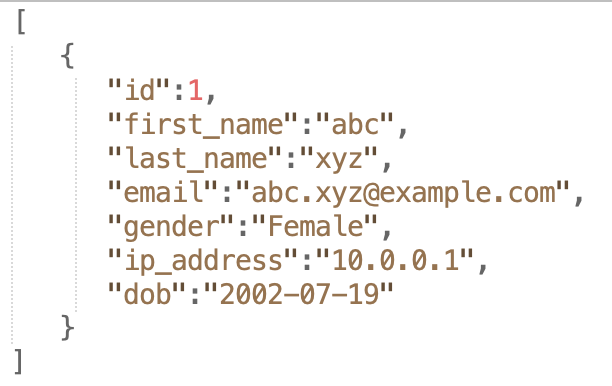
For JSON file formats, you can use the data file itself or a subset of the file you want to mask as the format.
Parquet files
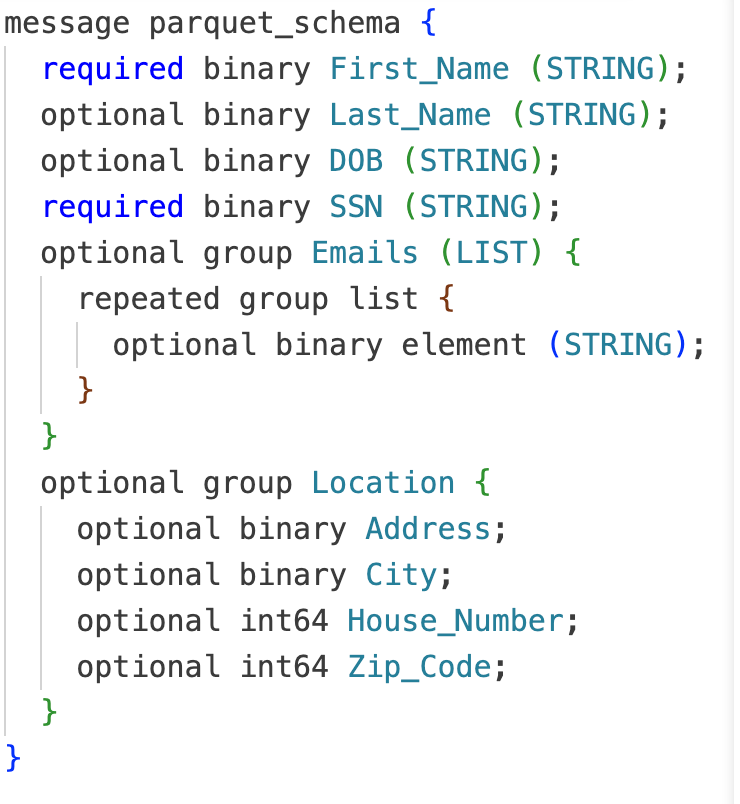
For parquet file formats, you can use the data file itself or a subset of the file you want to mask as the format. Alternatively, you can upload a .txt or .fmt file containing the file schema (example below).
When creating or editing file format definitions on Windows, ensure the file uses Unix-style (LF) line endings instead of Windows-style (CRLF). Files saved with CRLF line endings may appear syntactically correct but can fail Java-based validation or parsing during upload. Convert the file to LF line endings before uploading.
Mainframe files
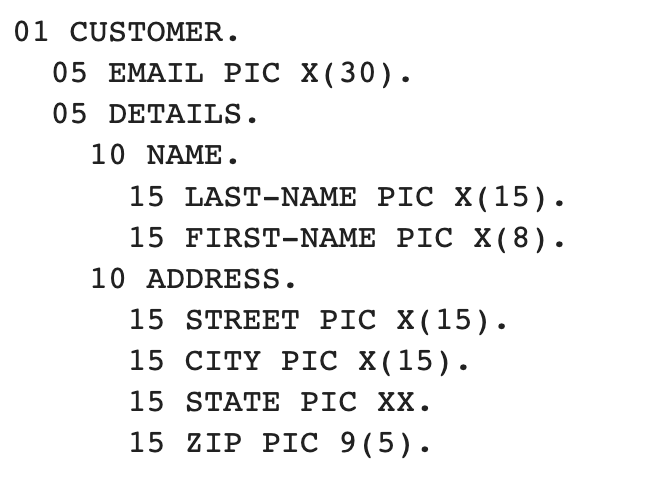
For Mainframe files, you can use the copybook file as the format.